When Storms Threaten Lives, Words Matter


News outlets have to follow a certain narrative in order to cover certain news events. The necessity of driving traffic to rake in advertising money often outweighs the urge to accidentally commit journalism, requiring the development of a sort of prefab narrative when covering the news. Political reporting often uses the “horse race” narrative in order to cover elections, whether or not the opponents are actually running close to one another. Sports media goes weak at the knees for an underdog. Once a news outlet sticks to The Narrative long enough, it turns into an unbreakable habit. When it comes to the weather, this particular narrative is that the weather forecast was wrong, no matter what, and that the victims of a disaster were taken off-guard by the disaster, no matter what.
The myth of the dumb, lying weatherman is so deeply woven into the American tapestry of falsisms that it’s not a matter of if it’s claimed lives, but a question of how many people have died because they thought they knew better than their friendly neighborhood meteorologist. We encounter this kind of ignorance in everyday conversation—you’re bound to engage in small talk with someone who eventually talks about the weather forecast, concluding with the trusty ol’ line “but they don’t know what they’re talking about, so who knows what’s going to happen.”
This was a bad week for severe weather in the United States. Destructive storms are bad any time of the year, but it’s even worse during the holidays. Millions of people travel during this one week of the year, visiting unfamiliar areas of the country in order to enjoy the time they have off from work and school. Even worse, we’re approaching the middle of meteorological winter, a time when more people are concerned about roads icing over than they are about a tornado sweeping their house away. People simply not paying attention to forecasts of severe weather make tornado outbreaks in December even more dangerous than they’d be in a “normal” situation, if there is such a thing.

The severe weather outbreak on Wednesday, December 23 saw 348 reports of damaging winds, large hail, or tornadoes come through to the Storm Prediction Center. Of those reports, 51 of them were for tornadoes, and many of these tornado reports were for the same long-track tornadoes. The most significant tornado occurred across northern Mississippi into southern Tennessee; a preliminary EF-3 with maximum winds of 160 MPH, the tornado stayed on the ground for two and a half hours, traversing 145 continuous miles and reaching a maximum width of 0.75 miles. The tornado killed at least seven people.
Meteorologists began talking about the threat for severe weather on Wednesday as early as a week before the event, and the Storm Prediction Center officially included the area under a 15% risk for severe weather in its day four outlook on December 20:

On December 21, three days out, they included the area under a slight risk for severe weather:

On December 22, two days out, this slight risk was upgraded to an enhanced risk, a three on a scale from one to five:

At 7:00 AM CST on December 23, the day of the outbreak, the agency issued a moderate risk for severe weather due to the increasing threat for tornadoes, outlining the area under a 15% risk for significant (EF-2+) tornadoes.

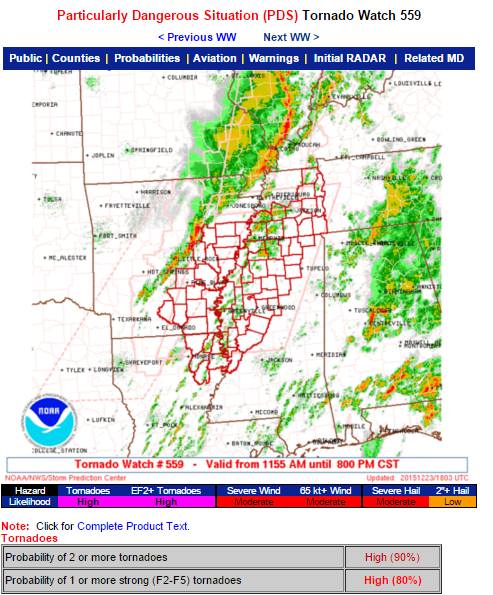
At 11:55 AM CST on Wednesday, December, 23, the Storm Prediction Center issued a Particularly Dangerous Situation (PDS) Tornado Watch for the Mississippi River Valley from Louisiana north through western Tennessee. A “particularly dangerous situation” is enhanced wording attached to a tornado watch when numerous violent, long-track tornadoes are possible. PDS watches are reserved for the most dangerous severe weather days, and before December 23, the last PDS Tornado Watch issued by the agency was in June 2014 in Nebraska.
The EF-3 tornado that tore through northern Mississippi and southwestern Tennessee that afternoon touched down at 2:58 PM CST, according to the latest report from the National Weather Service office in Memphis. The first tornado warning on this particular storm was issued at exactly 3:00 PM CST—two minutes after the tornado touched down according to the preliminary storm survey—and the storm was continuously warned over the initial tornado’s 145-mile track, continuing on until the storm lost rotation over the Nashville metro area. This supercell was tornado-warned from 3:00 PM CST until 7:47 PM CST, providing five hours of continuous notice for people in the path of the storm’s strong rotation.
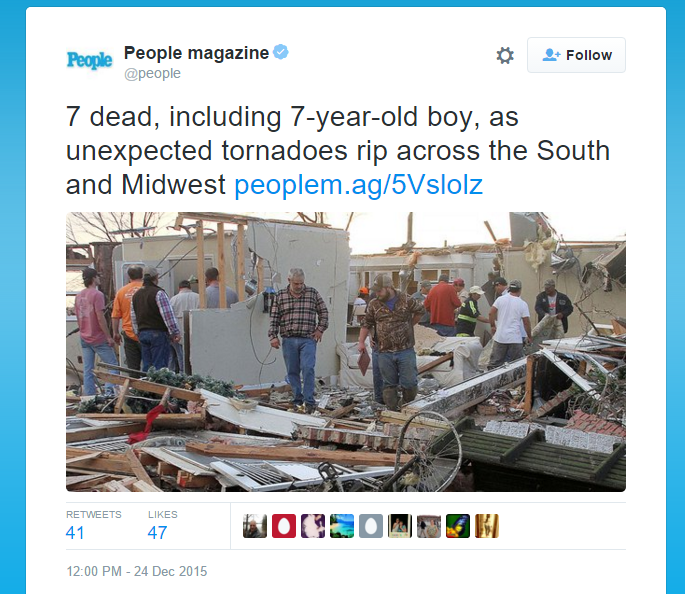
This weekend, People Magazine posted an article on its website with a headline exclaiming that an “unexpected” tornado outbreak claimed seven lives in the South and Midwest on Wednesday, December 23. This kind of dramatic language is what blogs thrive on—The Narrative, after all, is that meteorologists don’t know what they’re talking about, so even when they get it right, they were somehow wrong. The headline was corrected after widespread condemnation on social media. The headline still went out to tens of thousands (if not hundreds of thousands) of people before it was corrected, so the damage is done, and thus the myth of the dumb, lying weatherman guessing at a wrong forecast chugs forth unrestrained.
Just one day after the People incident occurred, television meteorologists like James Spann posted screenshots of one social media attack after another, launched his way by irate viewers who were ticked that his station, ABC 33/40 in Birmingham, Alabama, preempted a basketball game in order to cover widespread deadly flooding and a handful of tornadoes that plagued central Alabama on Christmas Day, claiming multiple lives, washing out major roads, and destroying dozens of homes and businesses.
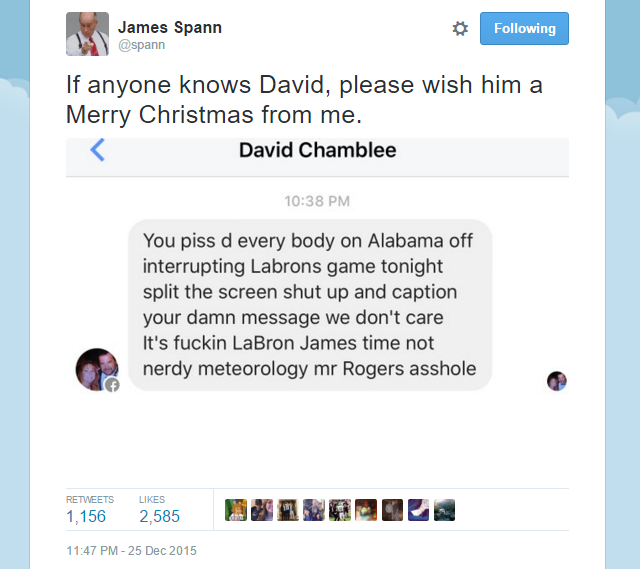
This is also nothing new. There’s a long, ugly history of television stations and broadcast meteorologists receiving vitriol—up to and including death threats—when they have to break into regular programming in order to cover severe weather. I used to cover this over on The Vane (see here and here), and Dr. Marshall Shepherd added his desire for viewers to crack this ugly habit to his list of New Year’s resolutions over at his blog on Forbes.
When the People Magazine incident occurred, meteorologists and weather enthusiasts weren’t completely in lock step on how to handle the situation. On one side, many folks (myself included) were pissed off that they chose to categorize a well-forecast severe weather outbreak as “unexpected,” likely in some misguided attempt to drive traffic by feeding into the myth of the lying weatherman. James Spann tweeted that he would argue with these “jabronis” if it wasn’t Christmas Eve. For every four or five messages lambasting People for publishing a crappy headline, there were a couple of tweets saying that we should ignore it and that the reaction is overblown. “It’s just a tabloid!,” I saw multiple folks exclaim, pretending like they don’t know that People Magazine’s audience is likely to believe everything People Magazine writes.
Ignoring crappy statements like the one People tried to pass off this week is exactly the kind of behavior that allows people to delude themselves into thinking that every tornado warning is crying wolf, that every forecast is an uneducated guess designed to drive ratings and traffic to the station’s advertisers, and that meteorologists are lying or making things up. After all, it’s the only job where you can be wrong all the time and not get fired!, says the worst person in the room.
Words matter. Even some tabloid like People has a reach that far exceeds what many of us are able to accomplish. A lie or myth or hoax can travel around the world a hundred times before a weather geek can turn on his or her computer. People who read weather blogs or follow weather geeks on social media already have a pretty solid idea of what goes into a forecast and what to take seriously. People Magazine reaches a demographic that largely couldn’t care less about the weather. I ran into that problem all the time writing about the weather for Gawker—their audience, mostly “the average person,” isn’t tuned in to the weather and mostly couldn’t care less.
When we pretend that words don’t matter, we get people who send meteorologists death threats for covering a tornado 20 miles away instead of airing a sporting event or popular television show. When we pretend that words don’t matter, we get people who ignore tornado warnings thinking it’s another false alarm, only for their life to end in a ditch half a mile away from their living room. When we pretend that words don’t matter, we wind up watching the news as they show tornado victims shouting “WE HAD NO WARNING” and baffled reporters saying it was completely unexpected, even though they had days and days to prepare.
Words matter, and we need to do our very best to make sure people know when to take threats seriously and stop brushing it off. The myth of the lying weatherman has and will continue to cost lives—we’ll never be able to completely prevent death or ignorance, but we have a responsibility to try like hell.
[Maps: SPC | Radar: Gibson Ridge | Tweets: People Magazine, James Spann]