NOAA’s Newest Weather Satellite Isn’t Working Properly

One of GOES-17’s most important instruments can’t cool off properly. NOAA broke the bad news today concerning the new weather satellite the United States launched into orbit back on March 1 of this year. The news comes not long after the first test products from the new satellite were released, sending back information about space weather and showing vivid lightning in thunderstorms across the United States earlier this month.
The press release on the agency’s blog is enough to put a lump in the throat of weather enthusiasts:
The GOES-R Program is currently addressing a performance issue with
the cooling system encountered during commissioning of the GOES-17
Advanced Baseline Imager (ABI) instrument. The cooling system is an
integral part of the ABI and did not start up properly during the
on-orbit checkout.A team of experts from NOAA, NASA, the ABI contractor team and
industry are investigating the issue and pursuing multiple courses of
possible corrective actions. The issue affects the infrared and
near-infrared channels on the instrument. The visible channels of the
ABI are not impacted.NOAA’s operational geostationary constellation — GOES-16, operating
as GOES-East, GOES-15, operating as GOES-West and GOES-14, operating as
the on-orbit spare — is healthy and monitoring weather across the
nation each day, so there is no immediate impact from this performance
issue.If efforts to restore the cooling system are unsuccessful,
alternative concepts and modes will be considered to maximize the
operational utility of the ABI for NOAA’s National Weather Service and
other customers. An update will be provided as new information becomes
available.
The GOES-R family of satellites contains a number of cool scientific instruments to help folks back on Earth monitor different aspects of our planet and the Sun. The Advanced Baseline Imager (ABI) is the instrument that gives us the visible, infrared, and water vapor satellite images we see on a daily basis.
Mechanical issues in space are…not good!, to say the least. There’s no
fixing it if something mechanical breaks on a satellite. Engineers
only have technical and software tricks and workarounds to try to
resolve issues like this.
Satellites get hot and they need cooling systems in order to operate. If technicians can’t get the ABI’s cooling system to work properly, NOAA says they’ll have to work with what they’ve got. Visible imagery is great, but meteorologists need all 16 bands made available by the ABI to fully analyze the atmosphere.
GOES-17 is scheduled to be the western counterpart to GOES-16, the satellite launched in November 2016 and put into regular service this past December to keep a watchful eye over the Atlantic Ocean and eastern North and South Americas. The satellite was scheduled to go into operational service later this year, but it’s unclear when or even if that will happen given these latest developments.
The additional wavelengths and dramatically improved spatial and temporal resolution of the new GOES family of satellites puts the old satellites to shame. Meteorologists can now watch thunderstorms, hurricanes, and even wildfires with sharp imagery that updates almost in real-time. Hopefully they’re able to troubleshoot the cooling system on the new satellite so we can have this kind of coverage across the entire western hemisphere.
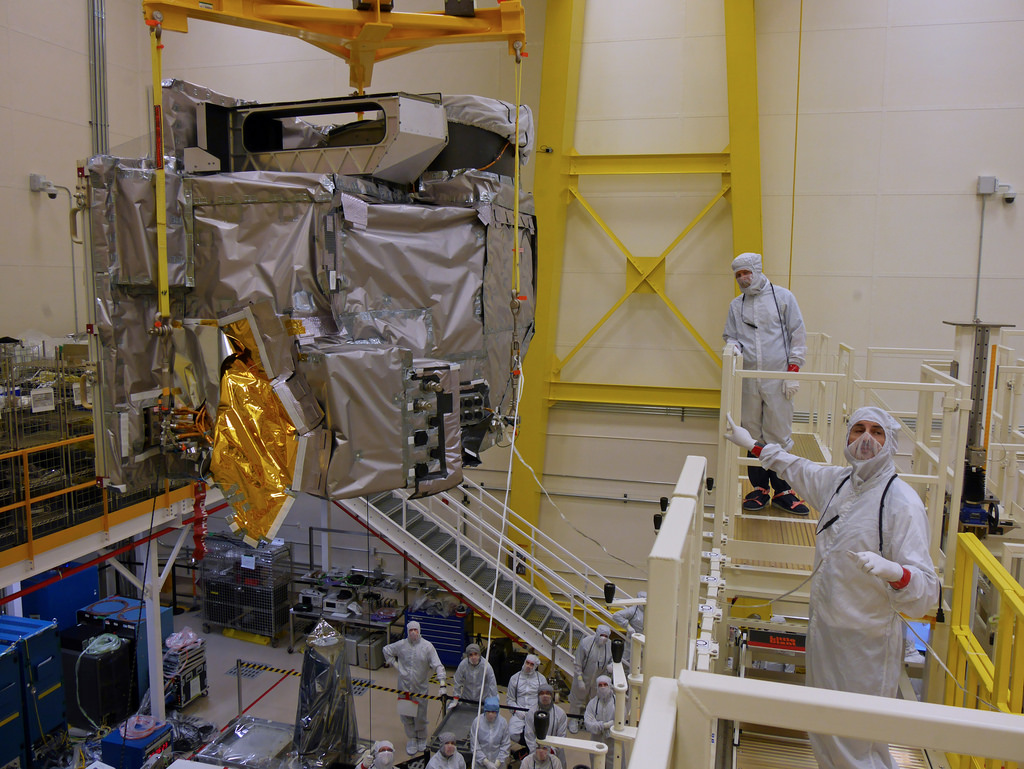
[Image: Scientists install the ABI on GOES-17 at Lockheed Martin’s Gateway Center near Denver, Colorado, via NOAA/NASA]