Let’s Talk About Tonight’s Made-Up-Clickbait-Name Moon

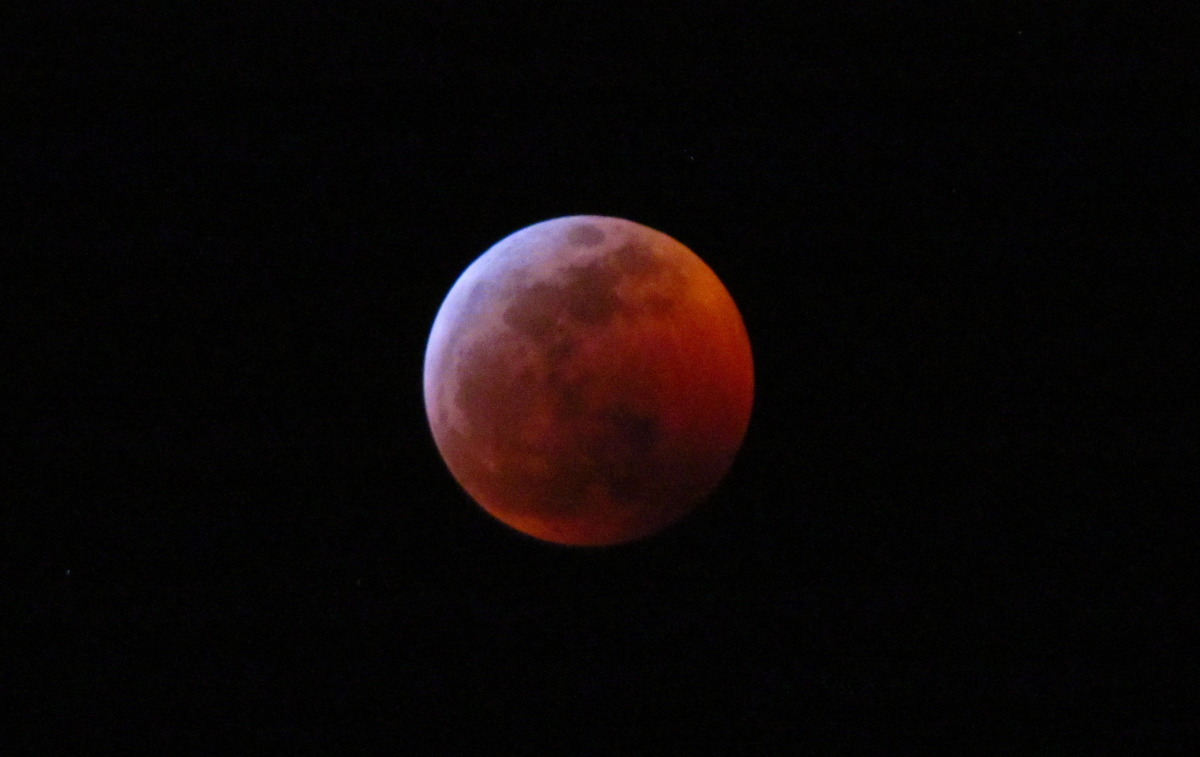
Did you hear about the moon tonight? The moon is a wonderful sight every night, but sometimes it gives us a real treat. Tonight’s moon has been dubbed—and I typed this in the most passive, judgmental way possible—the “Super Flower Blood Moon,” which, to my great disappointment, is not the name of Elon Musk’s second child, but rather some hyped-up amalgam news editors decided to use to lure people into clicking on posts they would otherwise scroll by.
Bloggers and news outlets have a strange relationship with astronomy. An interesting event can’t just be a lunar eclipse or a noteworthy alignment of the planets. We have to come up with flashy names to sell the story to people who might not care.
One great example is last year’s “Christmas Star.” Remember that? Saturn and Jupiter passed very close to one another in our night sky late last December, appearing to the naked eye like a bright star suddenly appeared near the horizon.
The conjunction of the two planets quickly earned its nickname, and many popular news articles and social media pages illustrated the upcoming event with Christian-themed art that featured a prominent twinkling cross in the night sky. Many (many, many, many…) people came to expect a giant cross to appear in the sky as a result of this coverage, finding only disappointment when they saw a bright star on the southern horizon after sunset.
It’s strange how things take on a life of their own. It’s obvious why the polar vortex became a sensation in 2014—it froze a critical mass of America’s journalists and it’s a great term that hardly anyone had heard before. But the moon falls victim to this strange phenomenon more than anything else outside of our atmosphere through a combination of longstanding lore and a need for traffic.
That brings us to the “Super Flower Blood Moon,” which should earn someone a marketing award. Whew.
Let’s break down the name bit by painful bit:
Super
The moon’s orbit isn’t perfectly centered on Earth. The moon is about 224,000 miles away from Earth at its closest point, called the perigee, and about 251,000 miles away at its farthest point, called the apogee.
Occasionally, the full moon will occur during perigee or apogee. A full moon during perigee is known as a “super moon” because it appears a little bit bigger in the sky compared to other full moons. (A full moon at apogee is a “micro moon.”) The embiggening of a super moon is barely perceptible unless you’re good at photography.
Flower
We’ve always had names for different full moons depending on the month or season. There’s the Harvest Moon, the Wolf Moon, and the occasional Blue Moon when two full moons occur during the same month. A full moon during the month of May is called a Flower Moon, because flowers bloom in May. (Clever, right?)
Blood
Lunar eclipses are sometimes called “blood moons” due to the rusty red appearance of the moon’s surface at the peak of a total lunar eclipse. Even though the moon is covered by Earth’s shadow, light still passes through Earth’s atmosphere and reaches the lunar surface. All the gasses and pollutants in our atmosphere scatter out the shorter wavelengths like blue and green, leaving only dark red light to escape our grasp and reach the moon.
The term’s popularity is relatively new, and it’s largely due to evangelical pastors (such as John Hagee) using the phrase in relation to their prophecies about the end times.
Moon
Because it’s the moon.
 |
| Source: NASA |
If you’re lucky enough to spot tonight’s lunar eclipse—which is most visible in the Pacific region and the western half of the United States—please get out there early on Wednesday morning and enjoy the sight. It’s really wonderful to catch a full lunar eclipse in all its glory. Astronomy is awesome. Our atmosphere is awesome. We don’t need to gussy them up with ridiculous terms to get people interested in the skies above. (Speaking of which…I can’t wait to share what I’ve been working on for the past five months!)
Correction: A commenter who’s much smarter than I am pointed out I was wrong to say “the moon’s orbit around Earth isn’t perfectly circular.” The Moon’s orbit is not perfectly centered on Earth, accounting for the difference in distances between apogee and perigee. I corrected and apologize for making a mistake while mocking people who make mistakes.
[Top Image: Me (Not me me. Taken by me. I am not the moon.)]
You can follow me on Twitter or send me an email.
Please consider subscribing to my Patreon. Your support helps me write engaging, hype-free weather coverage—no fretting over ad revenue, no chasing viral clicks. Just the weather.